
Survey: the majority agree that heavyweight transport should be taxed according to the impact it has on roads
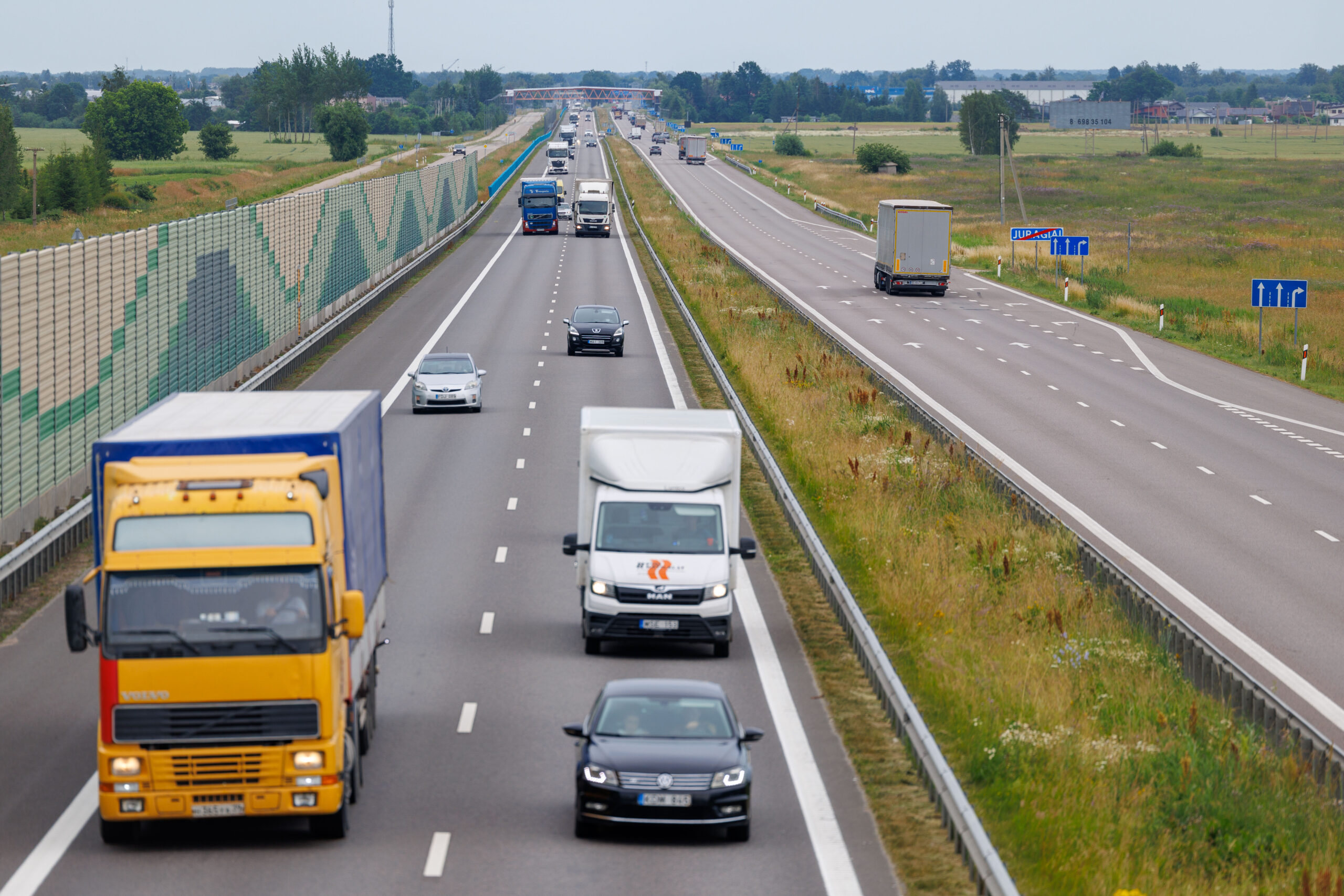
Almost seven out of ten Lithuanian residents believe that heavy freight and passenger transport causes more road infrastructure wear and tear than passenger cars. More than half of the respondents also agree with the principle that owners of such vehicles should pay for road use in proportion to the impact they have on the roads. These were the findings of a representative survey of the country’s population commissioned by the company Via Lietuva.
“I am delighted that Lithuanians support the fair principle that those who use the roads more intensively and cause greater wear and tear on them should contribute more towards their upkeep. Together with my team, we have set in motion processes that had been stalled for many years and ensured that Lithuania transitions to a more modern system of heavy goods vehicle taxation, which has long been in place in many European countries. The Via Toll system, which will come into operation next year, will be an important part of the ‘STOP Road Damage’ programme, and all the funds collected will be reinvested in Lithuania’s roads so that our journeys are safer and more comfortable, and the roads last longer,” says Juras Taminskas, Minister of Transport and Communications.
“Most residents agree that freight and passenger transport have a greater impact on road wear and tear, and therefore support the principle that those who make more intensive use of the infrastructure should contribute proportionally more to its maintenance. It is precisely this principle that underpins the Via Toll electronic road toll system, which will come into operation in Lithuania from the start of 2027,” says Martynas Gedaminskas, CEO of Via Lietuva.
In total, 68 per cent of respondents believe that freight and passenger transport have a greater impact on road infrastructure than passenger cars. Almost half (48 per cent) of those surveyed are convinced that the negative impact is significantly greater, whilst a further fifth (20 per cent) believe it is slightly greater.
Research carried out by academics at Vilnius Tech University shows that the impact of heavy goods vehicles on road surfaces is considerably greater than that of passenger cars and accounts for around 90 per cent of total road infrastructure wear and tear.
According to the researchers’ calculations, a single fully loaded Category N3 lorry, with a maximum authorised mass of up to 40 tonnes, can have the same impact on one kilometre of road surface as around 10,500 Category M1 passenger cars.
To ensure that the use of heavy freight transport contributes to the financing of road infrastructure, road user charges have been applied to operators for many years, which they pay when purchasing a vignette. From 1 January 2027, vignettes will be replaced by Via Toll, marking a transition to distance-based charging.
As M. Gedaminskas notes, the Via Toll electronic road toll system is based on the principle of more proportionate and fairer charging.
“From 1 January 2027, operators of goods and passenger vehicles will pay for the distance actually travelled on the country’s toll roads, and the exact toll amount will be calculated taking into account the type of vehicle, the type of fuel and the emissions class,” says CEO of Via Lietuva.
Survey data shows that more than half (53 per cent) of the population agree that commercial transport should be taxed according to its impact on road infrastructure. Nine per cent of respondents disagree with this principle, whilst a further 26 per cent tend to take a moderate stance – neither agreeing nor disagreeing.
According to M. Gedaminskas, this is a fairer solution for both haulers and all road users, as more funds will be available for the maintenance and development of road infrastructure.
“The transition to distance-based tolls will allow road funding to be more closely linked to
actual infrastructure use. This means a more stable income for the maintenance of roads, bridges and other structures, so in the long run, not only haulers but all the country’s drivers will benefit,” says M. Gedaminskas.
All funds collected via the Via Toll system will be channeled into the State Roads Fund and used for the maintenance and development of road infrastructure. It is expected that around EUR 110 million will be collected from road tolls during the system’s first year of operation.
Via Toll will apply only to vehicles in categories M2, M3, N1, N2 and N3. Drivers of passenger cars in category M1 will not face any new road charges, but they will benefit from greater investment in road infrastructure.
A representative survey of the country’s population was carried out by the research company “Spinter tyrimai” on behalf of Via Lietuva. The survey was conducted between 18 and 28 June this year, during which 1,016 residents aged between 18 and 75 were interviewed across the country.